The fastest player in training is rarely the fastest player on the pitch. I have seen this pattern repeat across every team I have worked with — from national squads to academy players.
A midfielder runs a 10.9 hundred meters. Impressive. But watch him in a match, and he is consistently beaten to loose balls by teammates who would lose to him in a foot race.
The disconnect? We are training the wrong type of speed.

Soccer speed training that transfers to the pitch demands more than straight-line sprints. It requires reactive decision-making, multi-directional acceleration, and the ability to brake and re-accelerate under fatigue. This guide breaks down the three speed qualities that win matches, six drills that develop real game speed, and how to programme it all across a training week.
Why Speed Training for Soccer Players Demands a Different Approach
Here is a number that should reframe how you think about speed in football/soccer: Faude et al. (2012) analysed 360 goals in the German Bundesliga and found that straight sprinting was the most frequent powerful action preceding goals — involved in 45% of all goals scored. But here is the critical nuance that most coaches miss: the vast majority of those sprints were initiated reactively, without the ball, and without a pre-planned route (Faude et al., Journal of Sports Sciences, 30(7), 625–631).
GPS match analysis tells us that elite players perform 150–250 high-intensity actions per match, but the average sprint distance is only 10–20 metres (Vigne et al., 2010). Players rarely reach true top-end velocity. The sprints that matter are short, explosive, and almost always triggered by an external stimulus — a deflection, a teammate's run, an opponent's mistake.
A 2020 study published in Frontiers in Physiology on GPS monitoring in elite soccer confirmed that the number of high-intensity accelerations (greater than 3 m/s squared) and decelerations (less than negative 3 m/s squared) are among the most important metrics for both performance and injury prediction. This is not a track meet. This is repeated, chaotic, decision-driven speed expression.
And yet — walk into most training sessions and you will see players doing 40-metre sprints with full recovery, from a standing start, on a whistle. That trains one narrow quality. It misses the cognitive, multi-directional, and fatigue-resistant demands of match speed entirely.
The 3 Speed Qualities That Win Matches
Before programming a single drill, you need to understand the three distinct speed qualities that separate match-fast players from track-fast players.
1. Reactive Speed — Processing Before Moving
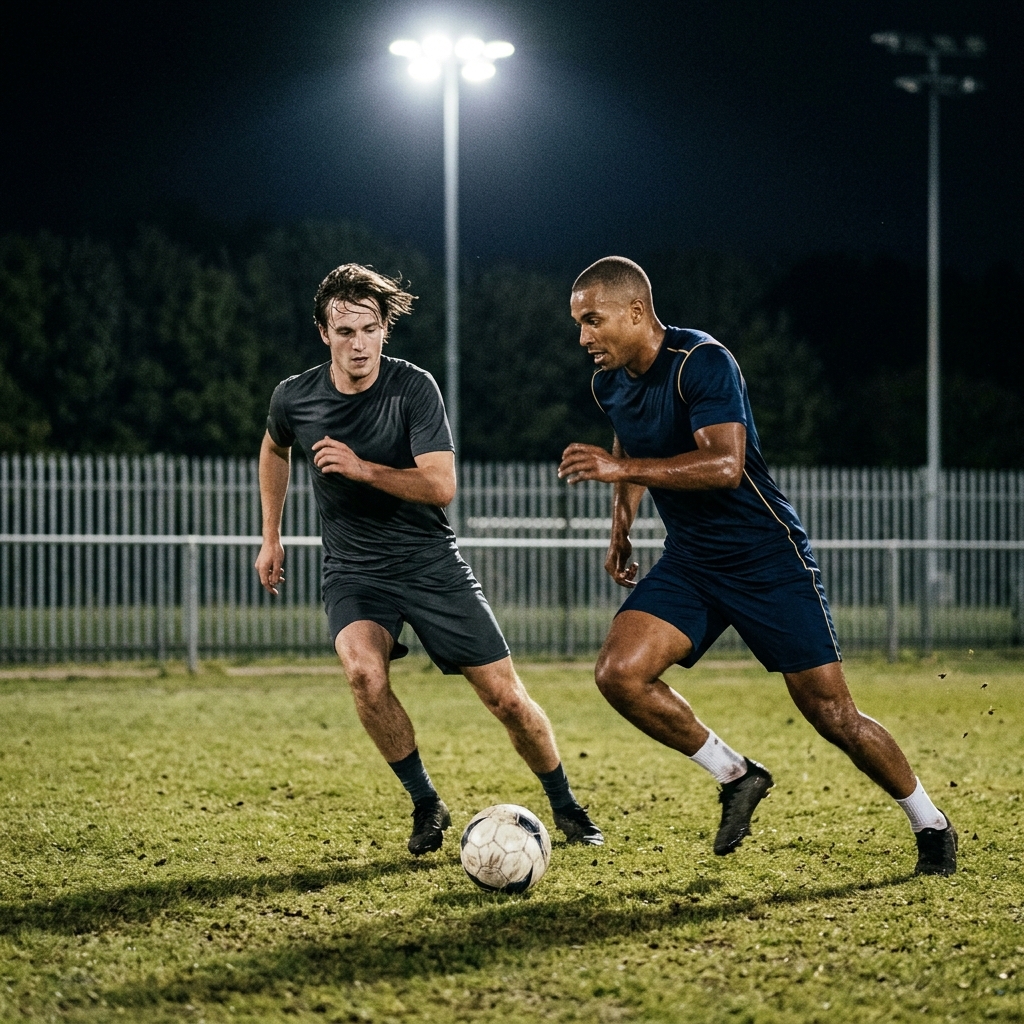
Reactive speed is the time between perceiving a stimulus and initiating the correct movement response. Research on reactive agility in soccer has consistently demonstrated that elite players outperform sub-elite players not primarily in movement speed, but in reaction movement time during reactive agility tests with live opponent stimuli (Sheppard et al., International Journal of Sports Science & Coaching, 2006). A 2024 study in the Journal of Human Sport and Exercise confirmed that perceptual-cognitive factors become an increasingly significant contributor to reactive agility as players mature.
In practical terms: the player who reads the deflection 200 milliseconds faster gets a two-metre head start that no amount of straight-line speed can recover.
2. First-Step Quickness — Winning in 3–5 Steps
Most soccer sprints cover 10–20 metres. At those distances, top-end velocity is irrelevant — what matters is the rate of force development in the first 3–5 steps. This is pure acceleration mechanics: shin angles, ground contact time, horizontal force application.
A player who reaches 85% of their max velocity in 5 metres beats a faster player who reaches the same percentage in 8 metres — every single time over match-relevant distances.
3. Deceleration — The Speed Quality Nobody Trains
The ability to brake efficiently — to absorb eccentric force, plant, and re-accelerate — creates separation more than raw speed ever will. GPS data from elite matches shows players perform as many high-intensity decelerations as accelerations. Yet most speed programmes dedicate zero specific volume to deceleration training.
There is also an injury dimension. Harper et al. (2019) demonstrated that uncontrolled deceleration patterns are a significant risk factor for hamstring and ACL injuries in football. Training deceleration is not optional — it is both a performance multiplier and an injury buffer.
Why Traditional Speed Training Falls Short for Soccer
Traditional speed work — planned, straight-line, fully recovered sprints — trains one narrow quality: maximum velocity acceleration in a predictable environment with zero cognitive load.
It systematically misses:
- Reactive decision-making. Players know exactly when they will start and where they will go. No scanning, no processing, no decision.
- Varied starting positions. Soccer players accelerate from backpedals, lateral shuffles, mid-turn, while tracking the ball — not from a sprinter's stance.
- Incomplete recovery. In a match, repeated high-intensity efforts occur without full rest. The ability to produce speed under accumulated fatigue is a distinct trainable quality.
- Multi-directional force application. Straight lines do not exist in soccer. You accelerate, brake, cut, and re-accelerate — often within a few seconds.
- Coupled perception-action. Match speed requires processing visual information while moving. Decoupling these in training produces athletes who are fast without the ball and slow with it.
A 2026 study published in Scientific Reports comparing reactive agility training to planned agility training in under-16 soccer players found that while both approaches improved sprint speed and change of direction, only the reactive agility group showed meaningful improvements in sport-specific agility test performance. The perceptual-cognitive component matters.
6 Soccer Speed Drills That Develop Game Speed
Each drill below includes setup, execution, volume, and a coaching cue. Programme 2–3 of these per session — not all six.
Drill 1: Reactive Starts from Varied Positions
What it trains: Reactive speed + acceleration from sport-specific postures.
Setup: Place a target cone 8 metres from a start area. The athlete begins in a different position each rep: facing away, lateral stance, seated on the ground, lying prone, or in a defensive backpedal.
Execution: A partner delivers a random visual cue (ball drop, hand signal) or auditory cue (clap) with unpredictable timing. On the cue, the athlete sprints to the target cone.
Volume: 6–8 reps. 45–60 seconds rest between reps.
Coaching cue: No self-starts. The cue must come from outside. The moment between perceiving the signal and initiating movement is where reactive speed lives. If the athlete is anticipating, vary the timing more aggressively.
Drill 2: Mirror Drills — 1v1 Reactive Shadowing
What it trains: Reactive agility + lateral speed + perceptual-cognitive processing.
Setup: Two players face each other in a 5-by-5 metre grid. One is the leader, one the mirror.
Execution: The leader moves freely — lateral shuffles, forward bursts, backward movement, cuts — while the mirror athlete attempts to stay directly opposite, matching every movement. Switch roles every 10 seconds.
Volume: 4–6 sets of 10 seconds per role. 30–40 seconds rest between sets.
Coaching cue: The leader should not telegraph movements. Emphasise sharp, sudden direction changes. Watch the mirror athlete's hip position — if their hips are square, they are reacting too slowly.
Drill 3: 5-Step Acceleration with Change of Direction
What it trains: First-step quickness + deceleration + re-acceleration.
Setup: Open space with a partner positioned to give directional cues.
Execution: Sprint 5 hard steps forward, plant on the outside foot, and cut 45 degrees in a direction called by the partner (or reactive to a rolled ball). Accelerate 3–4 steps in the new direction.
Volume: 6–8 reps (alternating cut directions). 45–60 seconds rest.
Coaching cue: The plant step is everything. Watch for players who take a stutter step before changing direction — that is a deceleration skill deficit. The penultimate step should load the outside leg with a low centre of mass.
Drill 4: Small-Sided Games with Sprint Triggers
What it trains: Decision-driven speed under sport-specific cognitive load.
Setup: Standard 4v4 or 5v5 small-sided game on a 30-by-20 metre pitch. The coach stands outside with coloured bibs or a ball.
Execution: Play proceeds normally, but when the coach raises a specific colour bib (or rolls a second ball onto the pitch), the nearest player from each team must sprint to a designated gate 15 metres away. First player through the gate wins their team a goal.
Volume: Integrate 6–10 sprint triggers across a 12–15 minute game. Recovery occurs naturally during play.
Coaching cue: The cognitive load of the game is the training stimulus. Players must maintain match awareness while being ready to sprint. This is the closest drill to actual match speed demands.
Drill 5: Deceleration Into Sprint
What it trains: Eccentric braking mechanics + deceleration-to-acceleration transition.
Setup: Two cones 15 metres apart with a 3-metre deceleration zone marked before the far cone.
Execution: Sprint 10 metres at 90%+ effort, decelerate over the 3-metre zone to a controlled stop (not a skid), hold a balanced athletic position for one full second, then explode back in the opposite direction for 10 metres.
Volume: 5–6 reps. 60–90 seconds rest.
Coaching cue: Quality over speed on the deceleration. Players should land balanced and controlled at the stop point, not lurching forward or taking extra steps. The shin angle at the stop should be near-vertical. If they are skidding, reduce the approach speed until the braking pattern is clean.
Drill 6: Decision-Based Sprint Circuits
What it trains: Repeated sprint ability with reactive decision-making under accumulating fatigue.
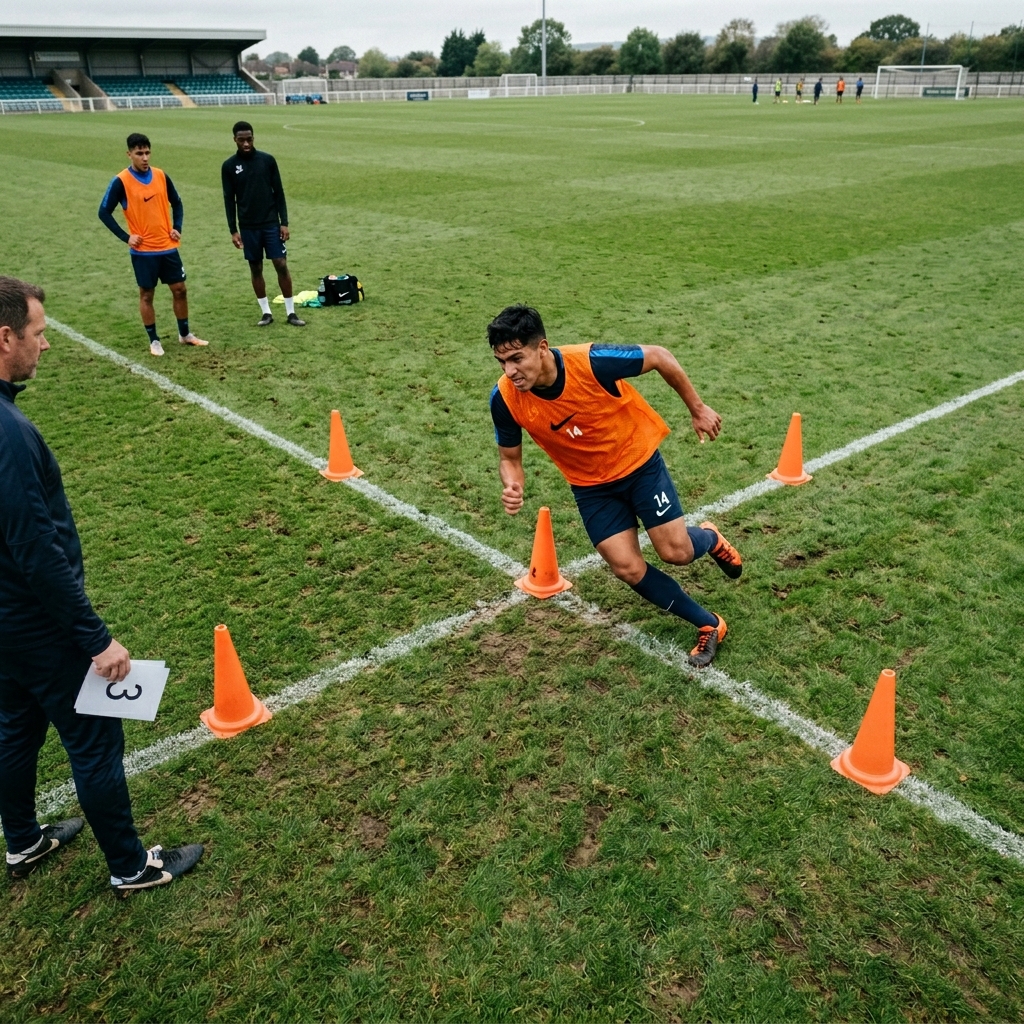
Setup: A central start cone with four target cones placed 10 metres away at 0, 90, 180, and 270 degrees (forming a cross pattern). A partner stands at the centre with numbered or coloured cards.
Execution: The athlete starts at the centre cone. The partner flashes a card — the athlete sprints to the corresponding cone, decelerates, returns to centre, and immediately reacts to the next card. Complete 4–6 consecutive sprints per set.
Volume: 3–4 sets of 4–6 sprints. 90–120 seconds rest between sets.
Coaching cue: Sprint quality must remain high throughout the set. If the last sprint in a set is noticeably slower than the first, reduce the number of sprints per set. This drill deliberately trains repeat-sprint ability under cognitive load — do not let it degrade into a conditioning drill.
Common Mistakes in Soccer Speed Training
1. Training Speed Under Fatigue
Speed work after 60 minutes of technical training is not speed work — it is conditioning with the intent of being fast. True speed development requires a relatively fresh nervous system. If players are pre-fatigued, you are training fatigue tolerance, not speed.
2. Overusing Ladder and Cone Patterns
Pre-programmed ladder and cone sequences train foot coordination, not agility. The athlete memorises the pattern, eliminating the reactive component entirely. As DeFranco and others have argued, these drills have their place in warm-ups, but they should never constitute the core of a speed session.
3. Ignoring Deceleration Volume
For every metre of acceleration you programme, there should be a corresponding deceleration demand. Many programmes feature 200+ metres of sprint volume with zero dedicated deceleration work. This is both a performance gap and an injury risk.
4. Neglecting the Perceptual-Cognitive Component
Speed without decision-making is track speed. If every rep in your speed session begins on a whistle with a pre-determined direction, you are only training half the speed equation. At minimum, 40–60% of your speed drill volume should include a reactive stimulus.
Programming Speed Work Across the Training Week
Speed work belongs early in a session, after a thorough warm-up but before significant neuromuscular fatigue. It also belongs early in the training week — furthest from the next match.
If you are managing speed training programmes for multiple athletes across different positions and training loads, a platform like PlayerPlan lets you build, assign, and track individualised speed sessions without spreadsheet chaos.
Sample In-Season Weekly Speed Programming
| Day | Session Focus | Speed Component | Volume | Intensity |
|---|---|---|---|---|
| MD-4 (Mon) | Speed Development | Reactive starts + acceleration drills | 8–10 reps | 95–100% |
| MD-3 (Tue) | Tactical + Speed Maintenance | Small-sided games with sprint triggers | Integrated (6–8 triggers) | 85–90% |
| MD-2 (Wed) | Strength / Power | Deceleration drills (low volume) | 4–6 reps | 90% |
| MD-1 (Thu) | Activation / Pre-match | None — tactical walk-through only | — | — |
| MD (Fri) | Match | — | — | — |
| MD+1 (Sat) | Recovery | — | — | — |
| MD+2 (Sun) | Return to Train | Decision-based sprint circuits (moderate) | 3 sets x 4 sprints | 85–90% |
MD = Match Day. Adjust based on your fixture schedule. The principle: highest speed training intensity should be placed furthest from match day.
Total weekly sprint volume (in-season): 20–35 high-quality sprint efforts, distributed across 2–3 sessions. Less is more — every rep should be maximal or near-maximal intent.
Recovery between reps: 45–90 seconds for short efforts (under 15 metres), 90–120 seconds for longer or repeated efforts. If you are training repeat-sprint ability, reduce rest deliberately to 20–30 seconds.
PlayerPlan's Session Builder lets you programme speed work with prescribed rest intervals, then share sessions directly to individual players. Coaches managing 10–20 athletes can differentiate speed volume by position without creating separate spreadsheets. Start a free trial here.
Key Takeaways
- Game speed is not track speed. Most soccer sprints are under 20 metres, initiated reactively, and performed under cognitive load. Train accordingly.
- Reactive speed separates elite from sub-elite. The perceptual-cognitive component — reading the game and initiating movement faster — is trainable and should feature in 40–60% of speed drill volume.
- First-step quickness wins more races than top-end velocity. Prioritise acceleration mechanics over maximum speed in your programming.
- Deceleration is a speed quality. It protects against injury and enables the re-acceleration patterns that create separation in matches.
- Programme speed fresh, programme speed first. Place it early in the session and early in the training week for maximal neural adaptation.
- Quality over volume. 8–12 maximal-intent efforts per session is sufficient. More is just fatigued repetitions disguising conditioning as speed work.
Speed Training for Soccer Players: Frequently Asked Questions
How often should soccer players train speed during the season?
Two to three dedicated speed sessions per week during pre-season, reducing to two sessions (one primary, one integrated via small-sided games) during the competitive season. The primary session should be placed 3–4 days before match day, when the neuromuscular system is freshest.
Can speed ladder drills improve soccer speed?
Speed ladders develop foot coordination and can serve as a useful warm-up tool, but they do not train the reactive, multi-directional speed demands of soccer. The movements are pre-programmed, short-range, and lack the perceptual-cognitive component that defines match speed. Use them as a warm-up complement, not a primary speed training method.
At what age should young soccer players start speed training?
Reactive games and movement skill development can begin at any age — these are simply well-structured play. Formal speed training with prescribed volumes and intensities becomes appropriate around ages 13–14, aligned with the onset of puberty and the associated increases in force production capacity. Younger athletes benefit more from varied movement exposure than structured sprint programming.
Is straight-line sprint training useless for soccer?
No. Faude et al. (2012) demonstrated that straight sprinting is the single most frequent powerful action in goal-scoring situations. The issue is not that straight-line speed is irrelevant — it is that it should not be the only speed quality trained. A well-rounded programme includes straight-line acceleration, reactive drills, multi-directional work, and deceleration training.
How do I know if my speed training is transferring to match performance?
Track match-specific metrics via GPS if available: number of high-intensity sprints, peak acceleration values, and repeated sprint recovery times across matches. Without GPS, use observational markers — who wins first to the ball, who creates separation in 1v1 situations, who maintains sprint quality in the final 15 minutes. If those indicators are improving, your speed training is transferring.
Speed training for soccer players is not about producing the fastest 40-metre time on the squad. It is about developing athletes who get to the ball first, create separation when it matters, and sustain their speed across 90 minutes of chaotic, decision-rich football.
Train reactive. Train short-burst. Train deceleration. Programme it intelligently across your week. The players who are fastest on the pitch are rarely the fastest on the track — but they are always the ones who trained for the match, not the stopwatch.
Ready to programme speed training for your entire squad — individualised by position, managed from one dashboard? Try PlayerPlan free for 30 days — build sessions, assign drills with prescribed rest intervals, and track athlete readiness so you know when to push speed work and when to back off. No credit card required.
References:
- Faude, O., Koch, T., & Meyer, T. (2012). Straight sprinting is the most frequent action in goal situations in professional football. Journal of Sports Sciences, 30(7), 625–631.
- Harper, D. J., Carling, C., & Kiely, J. (2019). High-intensity acceleration and deceleration demands in elite team sports competitive match play. Journal of Strength and Conditioning Research, 33(1), 268–276.
- Sheppard, J. M., & Young, W. B. (2006). Agility literature review: Classifications, training and testing. Journal of Sports Sciences, 24(9), 919–932.
- Vigne, G., Gaudino, C., Rogowski, I., Alloatti, G., & Hautier, C. (2010). Activity profile in elite Italian soccer team. International Journal of Sports Medicine, 31(5), 304–310.
- Mujika, I., Santisteban, J., Impellizzeri, F. M., & Castagna, C. (2009). Fitness determinants of success in men's and women's football. Journal of Sports Sciences, 27(2), 107–114.