A meta-analysis of 33 studies with nearly 1,500 young soccer players found that plyometric jump training improved sprint times, vertical jump height, and change-of-direction speed with moderate-to-large effect sizes — in as little as four to seven weeks (Ramirez-Campillo et al., 2020, Sports Medicine). A separate systematic review showed that injury prevention programs including plyometrics reduced ACL injury risk by up to 60% (Alanazi et al., 2022, Journal of Physiotherapy).
Those aren't marginal gains. That's the difference between winning the second ball and watching someone else win it.
Why Plyometrics Matter for Soccer
Every sprint, every aerial duel, every sharp cut into space relies on the stretch-shortening cycle (SSC) — the rapid eccentric loading and concentric contraction of muscle-tendon units that produces elastic, explosive force. Plyometrics train this cycle directly.
Strength training builds the engine. Plyometrics teach that engine to fire fast. A footballer with a strong squat but no reactive power is the player who finishes second in every 50/50. The SSC bridges the gap between what you can produce in the gym and what you can express on the pitch — rate of force development (RFD), ground contact time (GCT), and reactive strength index (RSI) all improve with targeted plyometric work.
Soccer/football demands this in every plane of motion: vertical (headers, challenging for high balls), horizontal (acceleration, sprinting), and lateral (cutting, defensive shuffles, change of direction). A complete plyometric program addresses all three.
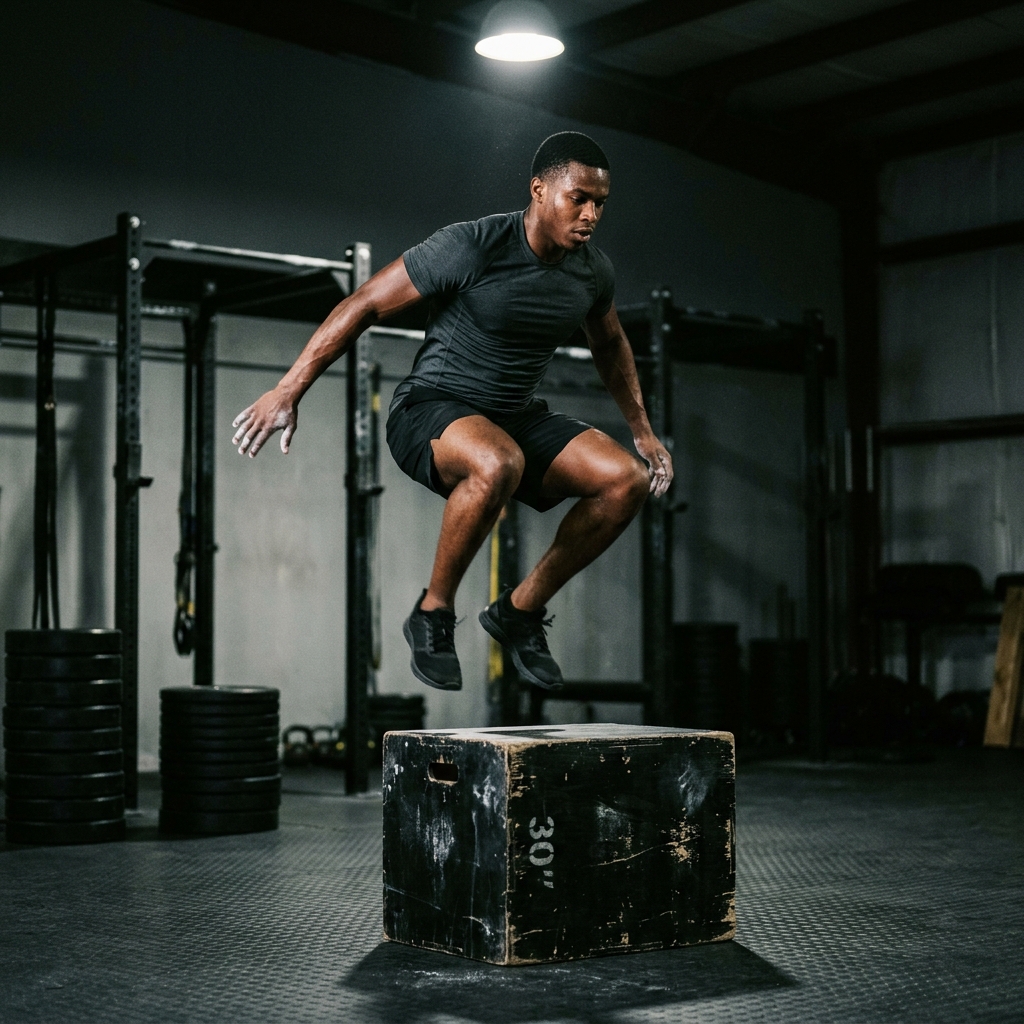
The 7 Exercises
1. Pogo Hops
Why it works: Pogo hops develop ankle stiffness and minimize ground contact time — two qualities that underpin every faster movement on the pitch. A stiff ankle-foot complex transfers force more efficiently during sprinting and cutting. Think of it as tuning the springs before you ask them to fire.
How to do it: Stand tall, feet hip-width apart. Hop rapidly off the balls of your feet, keeping the knees nearly locked and the ankles rigid. Minimize time on the ground. The movement comes from the ankle and calf, not the hips or knees. Stay vertical — no forward lean or excessive knee bend.
Sets/Reps/Rest: 3 x 15-20 contacts | 60s rest between sets
Key coaching cue: "Hot ground." Pretend the floor is burning — get off it as fast as possible. If you hear a loud slap on each contact, you're spending too long on the ground.
2. Broad Jumps
Why it works: Horizontal force production is the primary driver of acceleration — the first 10-15 meters of a sprint, which is where most soccer actions are decided. Broad jumps load the posterior chain eccentrically and demand a powerful hip extension, directly transferring to the pushing mechanics of sprinting.
How to do it: Stand with feet shoulder-width apart. Load by swinging the arms back and hinging at the hips. Explode forward and upward, extending the hips, knees, and ankles simultaneously. Land softly with flexed knees, absorb, and reset. Each rep is a maximal effort from a dead stop.
Sets/Reps/Rest: 4 x 4-5 jumps | 90s rest between sets
Key coaching cue: "Push the ground behind you." The intent is horizontal displacement, not height. If you're jumping up more than out, you're leaking force vertically.
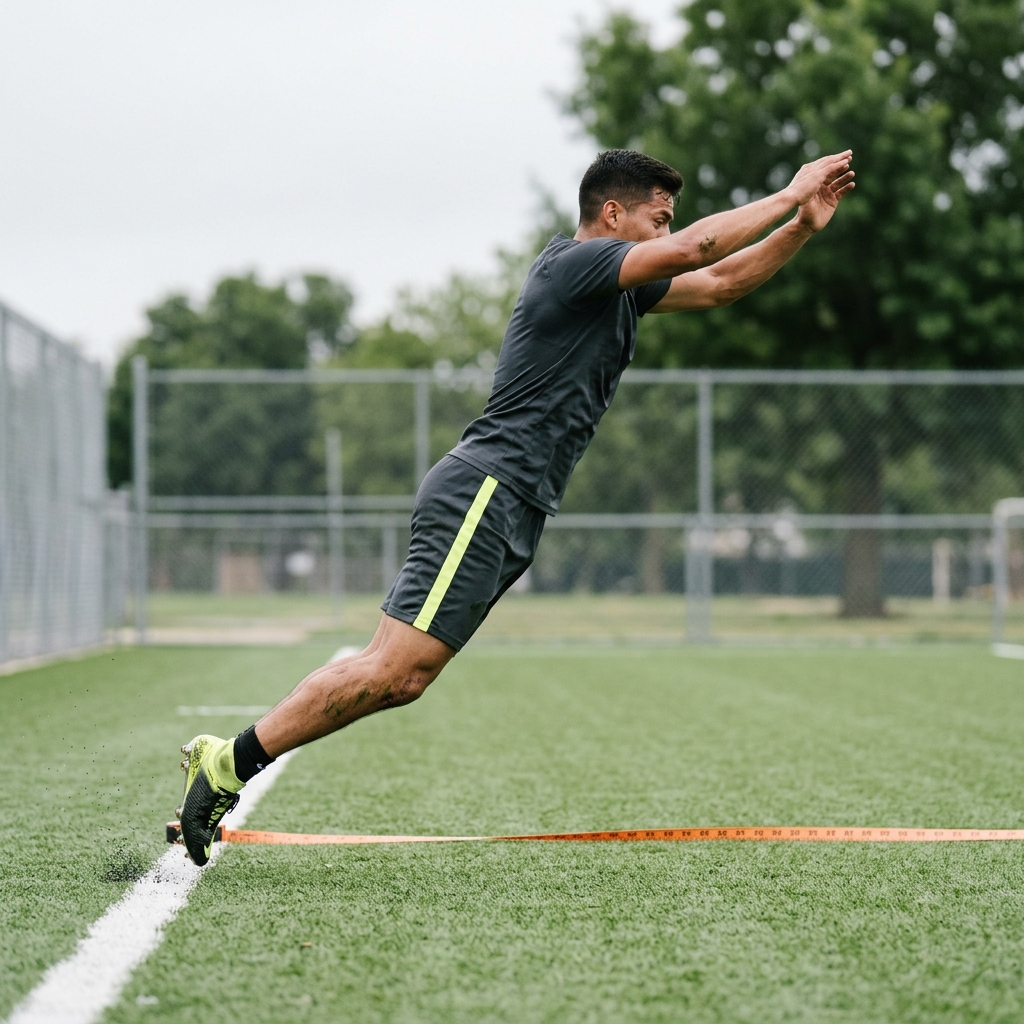
3. Single-Leg Bounds
Why it works: Sprinting is a unilateral activity — you're only ever pushing off one leg at a time. Single-leg bounds develop unilateral power, hip stability, and the alternating leg mechanics that mirror high-speed running. They also expose asymmetries between limbs that bilateral jumps hide.
How to do it: From a standing start or 2-3 step run-up, drive off one foot and bound forward, landing on the opposite foot. Emphasize a powerful knee drive on the swing leg and full hip extension on the push-off leg. Cover as much distance per bound as possible while maintaining control. Perform continuously for the prescribed distance or reps.
Sets/Reps/Rest: 3 x 5-6 bounds per leg | 90s rest between sets
Key coaching cue: "Tall and long." Chest up, hips high, reach with each stride. If the hips drop or the upper body collapses forward, the bound becomes a stumble.
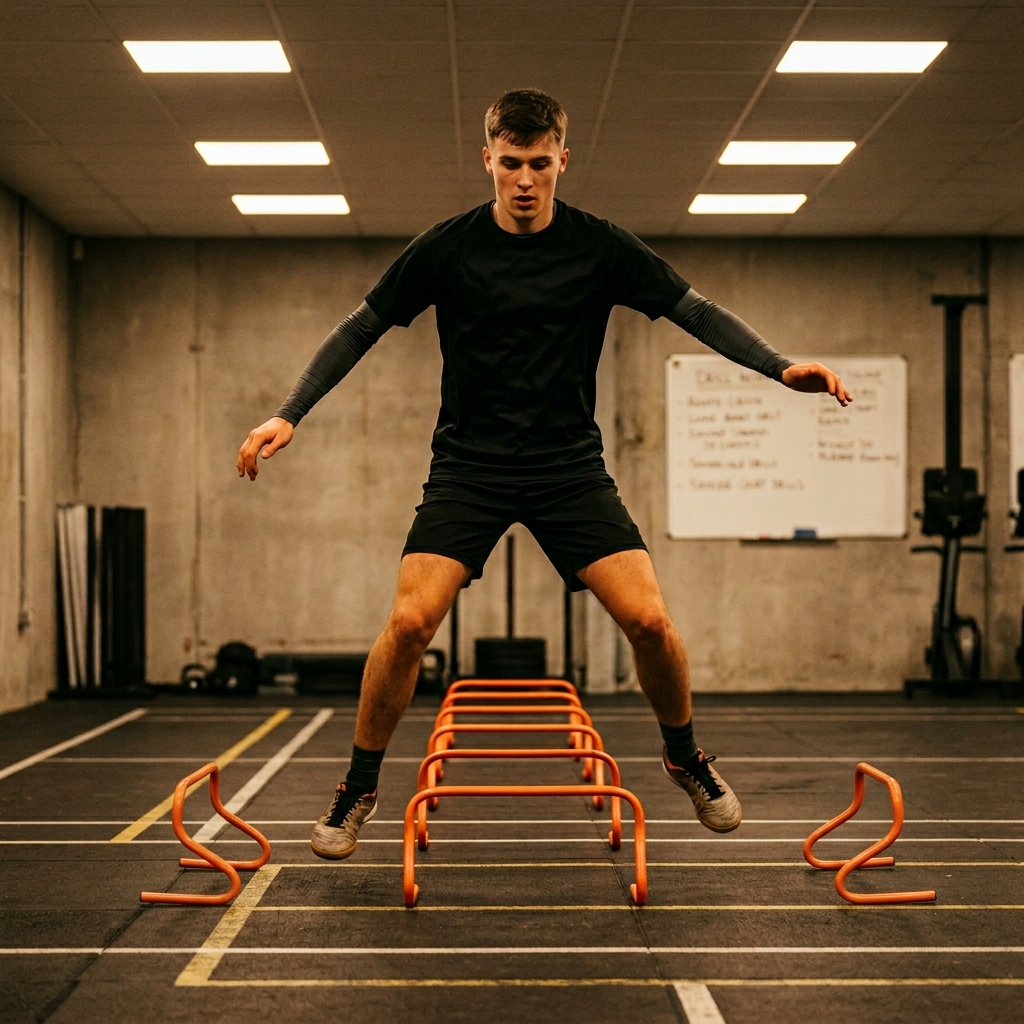
4. Lateral Hurdle Hops
Why it works: Soccer lives in the frontal plane more than most coaches program for. Every defensive slide, every lateral cut to beat a marker, every side-step to receive a pass in space — these demand lateral power. Lateral hurdle hops build frontal-plane reactive strength and train the adductors and abductors under high-speed eccentric-concentric loading, which is critical for change-of-direction (COD) performance.
How to do it: Set a low hurdle (15-30cm) to your side. Stand on one side, hop laterally over it, land on both feet, and immediately rebound back over. Keep the hips square and the core braced throughout. Ground contact should be fast and reactive — don't sink into a deep squat on each landing.
Sets/Reps/Rest: 3 x 8-10 hops (each direction) | 60-90s rest between sets
Key coaching cue: "Quiet feet, loud hips." The landing should be soft and controlled (quiet feet), but the lateral drive should come from an aggressive hip push (loud hips). If the knees cave inward on landing, reduce the hurdle height.
Managing plyometric progressions across a squad is one of the hardest parts of S&C programming. When you've got 20 players at different readiness levels — some in-season, some returning from injury, some peaking — tracking who should be doing pogo hops versus depth jumps gets complicated fast. PlayerPlan lets you assign individualized plyometric progressions to each athlete and adjust volume in real time based on their training load and wellness data.
5. Drop Jumps
Why it works: The drop jump is the purest expression of reactive strength. Stepping off an elevated surface and immediately rebounding trains the amortization phase — the brief transition between eccentric and concentric contraction. A shorter amortization phase means faster force production, which translates directly to quicker first steps and more explosive jumps.
How to do it: Stand on a box (20-40cm, scaled to ability). Step off — do not jump off — and land on both feet. Immediately upon ground contact, jump vertically as high as possible. The goal is minimum ground contact time with maximum jump height. Reset on the box between each rep.
Sets/Reps/Rest: 3 x 5 drops | 2 min rest between sets
Key coaching cue: "Step and spring." Step off the box like you're stepping off a curb, then react off the ground like a rubber ball. If you're spending more than a blink on the ground, the box is too high.
6. Box Jump to Sprint
Why it works: This bridges the gap between vertical power and horizontal speed — the exact transfer soccer demands. A header to win an aerial duel followed by an immediate sprint to track the second ball. An explosive first step out of a planted defensive stance. The box jump loads the posterior chain; the sprint applies that potentiation immediately.
How to do it: Perform a maximal box jump (height appropriate to ability). Land softly on the box, step down quickly, and immediately sprint 10-15 meters at full intensity. The transition from landing to sprinting should be seamless — no pause, no reset.
Sets/Reps/Rest: 4 x 3 (jump + 10-15m sprint) | 2 min rest between sets
Key coaching cue: "Land and go." The moment your feet touch the ground off the box, your intent shifts to horizontal. There is no gathering step, no readjustment. The sprint starts before you think about it.
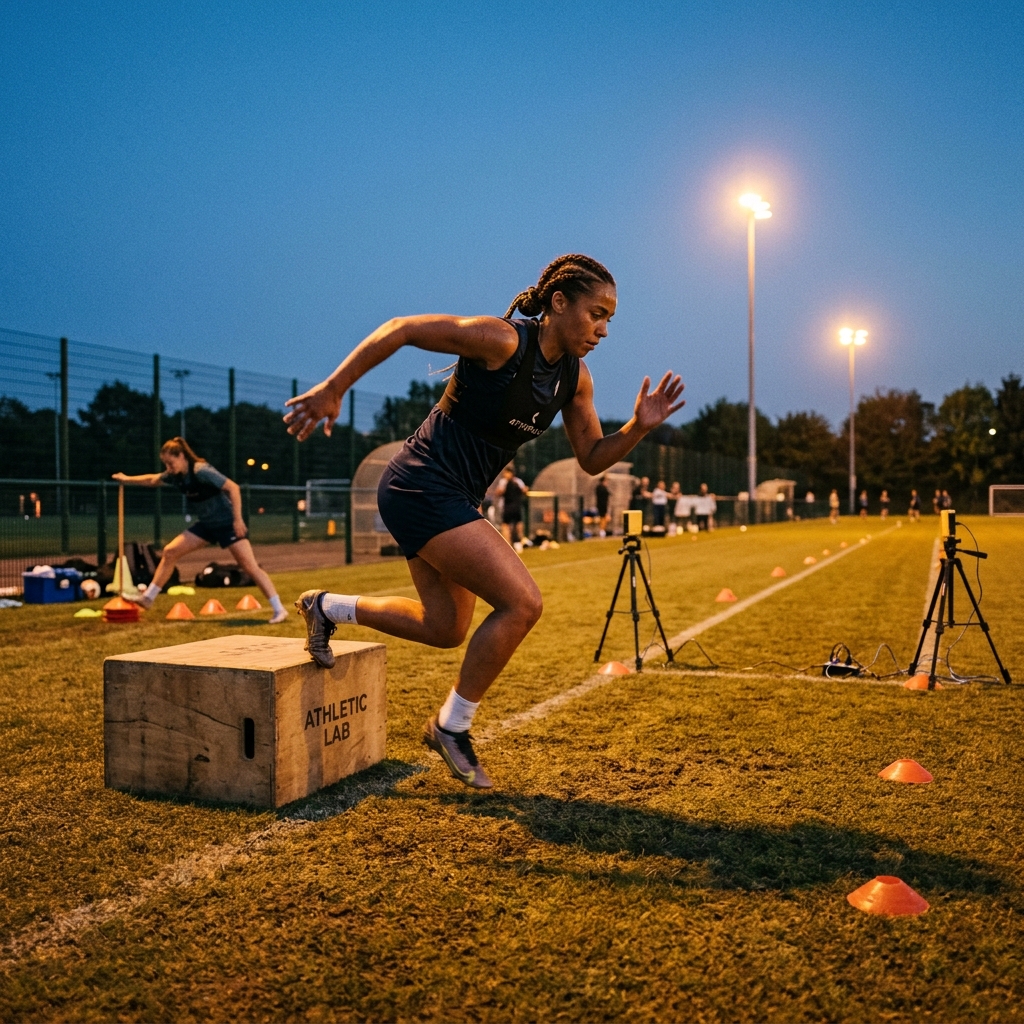
7. Depth Jump to Lateral Cut
Why it works: This is the most advanced exercise on the list and the most soccer-specific. It combines vertical reactive strength (depth jump) with a lateral change of direction — mimicking the exact movement pattern of winning an aerial challenge and immediately cutting to evade a defender, or landing from a contested header and reacting to a deflection. The eccentric demands are high, which also strengthens the structures that protect against non-contact knee and ankle injuries.
How to do it: Step off a box (20-30cm). Upon landing, absorb and immediately explode laterally at a 45-degree angle into a 3-5 meter sprint. Alternate the cut direction each rep or have a partner call the direction to add a reactive component. Land the initial drop on both feet, then push off the outside leg in the direction of the cut.
Sets/Reps/Rest: 3 x 4 per direction | 2 min rest between sets
Key coaching cue: "Drop, plant, explode." Three distinct intentions in one seamless movement. If the lateral cut feels sluggish, the box is too high or the athlete isn't ready for this progression.
Programming Plyometrics for Soccer
Getting the exercises right is half the equation. Getting the programming right is what separates improvement from injury.
Volume: Foot Contacts Per Session
Plyometric volume is measured in total foot contacts, not sets and reps in isolation. Guidelines based on training age:
- Beginner (< 1 year of structured plyometric training): 40-60 contacts per session
- Intermediate (1-2 years): 80-100 contacts per session
- Advanced (2+ years): 100-120 contacts per session
Count bilateral landings as one contact. Count unilateral landings as one contact per leg. A session of 4 x 5 drop jumps + 3 x 6 single-leg bounds per leg = 20 + 36 = 56 total contacts — appropriate for a beginner or early intermediate athlete.
Timing Within a Session
Plyometrics belong after the warmup and before heavy strength work. The nervous system must be fresh to produce maximal force at maximal speed. Post-strength plyometrics are just fatigued jumping — you'll train suboptimal mechanics and blunt the neural adaptations you're chasing.
A typical session order: dynamic warmup → plyometrics → strength → accessory work.
Frequency
- Pre-season: 2x per week — this is your window to build the foundation.
- In-season: 1x per week — maintain what you've built without accumulating excessive fatigue on top of match demands.
- Off-season: 2x per week alongside a strength block — the time to push volume and progress intensity.
Progression
Progress from low-intensity to high-intensity exercises across a training block:
- Low intensity: Pogo hops, broad jumps — master landing mechanics and reactive stiffness
- Medium intensity: Single-leg bounds, lateral hurdle hops — introduce unilateral and frontal-plane demands
- High intensity: Drop jumps, depth jump to lateral cut — high eccentric loads and complex reactive patterns
Do not skip steps. An athlete who cannot land a broad jump with controlled knee mechanics has no business doing depth jumps. Progression is earned through quality, not ambition.
Building plyometric sessions that respect these progressions — and adjusting them across a squad — is exactly what PlayerPlan's Session Builder and Exercise Library are designed for. Over 200 exercises with video demonstrations, drag-and-drop session construction, and the ability to share individualized sessions directly with each player. No spreadsheets, no guesswork.
FAQ
Are plyometrics safe for youth soccer players?
Yes — when programmed appropriately. Research supports plyometric training for youth athletes provided the exercises match the athlete's biological maturity and training age. Start with low-intensity, bilateral exercises (pogo hops, broad jumps) at conservative volumes (30-40 foot contacts). Emphasize landing quality over jump height or distance. The meta-analysis by Ramirez-Campillo et al. (2020) included adolescent players and found significant improvements with no reported increase in injury rates.
How many plyometric exercises should I include per session?
Two to three exercises per session is the sweet spot for most athletes. This allows sufficient volume per exercise to drive adaptation without accumulating excessive fatigue or degrading movement quality. Pair a low-intensity exercise with a higher-intensity one (e.g., pogo hops + drop jumps) to manage total stress while training different qualities within the same session.
Can plyometrics help prevent injuries in soccer?
The evidence is strong. A systematic review of cluster randomized trials found that injury prevention programs including plyometric exercises reduced ACL injury incidence by up to 60% (Alanazi et al., 2022). Plyometrics strengthen tendons, improve eccentric loading capacity, and enhance neuromuscular control during landing and cutting — all protective factors against the non-contact ACL and hamstring injuries that plague soccer players. They don't replace a full injury prevention protocol, but they're a critical component of one.
When should soccer players avoid plyometric training?
Avoid plyometrics when the athlete is acutely fatigued (within 24-48 hours of a high-intensity match), returning from a lower-limb injury without medical clearance, or during periods of heavy match congestion where recovery is already compromised. If an athlete reports significant muscle soreness, joint pain, or poor sleep quality, scale back to low-intensity options or skip the session entirely. Plyometrics demand a fresh nervous system — forcing them through fatigue trains bad mechanics and increases injury risk.
Build Explosive Sessions in Minutes
Every exercise in this article — and over 200 more — lives inside PlayerPlan's Exercise Library, each with full video demonstrations, coaching cues, and recommended sets and reps. The Session Builder lets you drag and drop exercises into structured sessions, set plyometric volume targets, and share the session directly to each player's phone.
Whether you're programming pogo hops for a returning academy player or depth jump complexes for your senior squad, PlayerPlan keeps every athlete on the right progression at the right time.
Start your free 30-day trial →
References:
- Ramirez-Campillo, R., et al. (2020). Effects of Plyometric Jump Training on Jump and Sprint Performance in Young Male Soccer Players: A Systematic Review and Meta-analysis. Sports Medicine, 50, 2125-2143.
- Alanazi, H., et al. (2022). Injury prevention programs that include plyometric exercises reduce the incidence of anterior cruciate ligament injury: a systematic review of cluster randomised trials. Journal of Physiotherapy, 68(4), 233-242.
- Ramirez-Campillo, R., et al. (2025). Effects of plyometric jump training on jump, sprint, and change of direction performance in adolescent soccer players: A systematic review with meta-analysis. PLOS ONE, 20(3), e0319548.
- Asadi, A., et al. (2016). Effects of Plyometric Training on Change-of-Direction Speed: A Meta-Analysis. International Journal of Sports Physiology and Performance, 11(5), 563-573.