Pre-season breaks players every year. Same story, different club.
Week one hits hard. Double sessions, long runs, intense conditioning. The players look fit. Coaches feel good about the work being done.
Week three arrives. Hamstrings start going. Players are flat. The high early loads catch up, and suddenly you're managing injuries instead of building fitness.
The problem isn't work ethic. It's periodization — or rather, the complete absence of it.
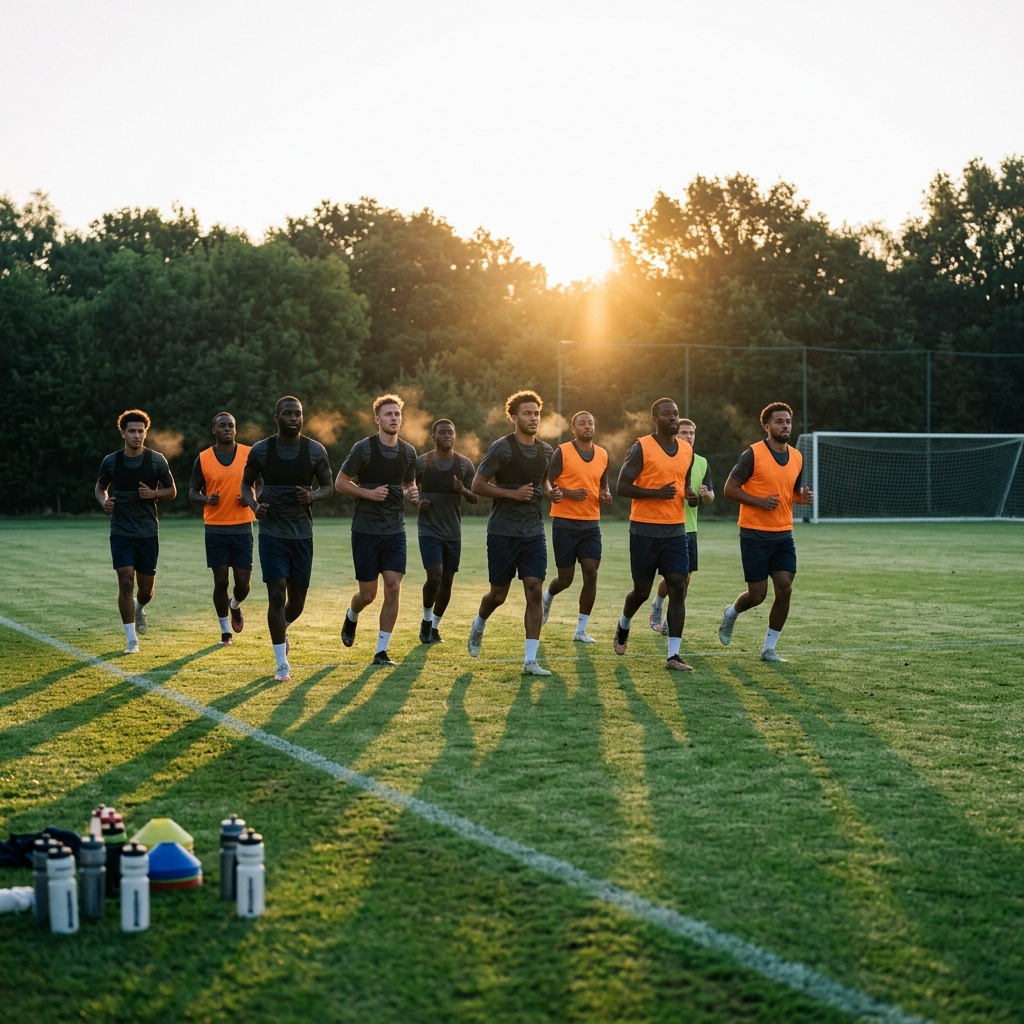
The Two Pre-Season Mistakes
Mistake One: Too aggressive, too early. Coaches see players coming back from off-season and panic. They're "unfit." Solution? Hammer them immediately. Except players' tissue tolerance is at its lowest after weeks of reduced activity. The muscles, tendons, and connective tissues haven't been loaded. They need progressive exposure, not an immediate assault.
Mistake Two: Too general, the whole time. Running laps builds aerobic capacity. But soccer fitness isn't just aerobic capacity. It's repeat-sprint ability, acceleration tolerance, the ability to recover while still moving. Generic fitness work doesn't transfer to match demands.
A well-designed pre-season avoids both extremes. It builds progressively, converts general capacity into sport-specific fitness, and delivers players to match day fresh and resilient — not exhausted from the previous six weeks.
The 6-Week Framework
Week 1: Foundation
Goal: Re-establish movement quality and baseline tolerance.
This week should feel easy. Players might even complain it's too light. That's fine.
S&C work:
- Bodyweight strength circuits (2x sessions)
- Mobility work daily
- Light resistance work focusing on movement patterns (hip hinge, squat, lunge, push, pull)
- Introduce eccentric loading gradually
Conditioning:
- Low-intensity aerobic work (running at conversational pace, cycling, pool work)
- Total volume: 20-30 minutes of continuous activity
- Zero high-intensity intervals this week
Why this matters: You're reintroducing load. Tendons adapt slower than muscles. Connective tissue needs time. The restraint in week one pays dividends in weeks four and five when intensity peaks.

Weeks 2-3: Build Phase
Goal: Develop strength and aerobic capacity with increasing volume.
Now you push. But progressively.
S&C work:
- 3x strength sessions per week
- Compound movements with progressive loading (squats, deadlift variations, pressing)
- Include eccentric hamstring work (Nordics, Romanian deadlifts)
- Start plyometric work at low-moderate intensity
Conditioning:
- Aerobic work increases in duration and intensity
- Introduce tempo runs and fartlek-style sessions
- Add short high-intensity efforts (10-15 seconds) with full recovery
- Small-sided games (SSGs) begin appearing, 3v3 and 4v4 primarily
Volume progression: Week 2 should be approximately 120-130% of week 1 volume. Week 3 can push to 140-150% of week 1.
Critical check: Monitor how players respond. Morning wellness questionnaires, training load tracking, simple "how do you feel" conversations. If players start accumulating fatigue with no recovery, back off.
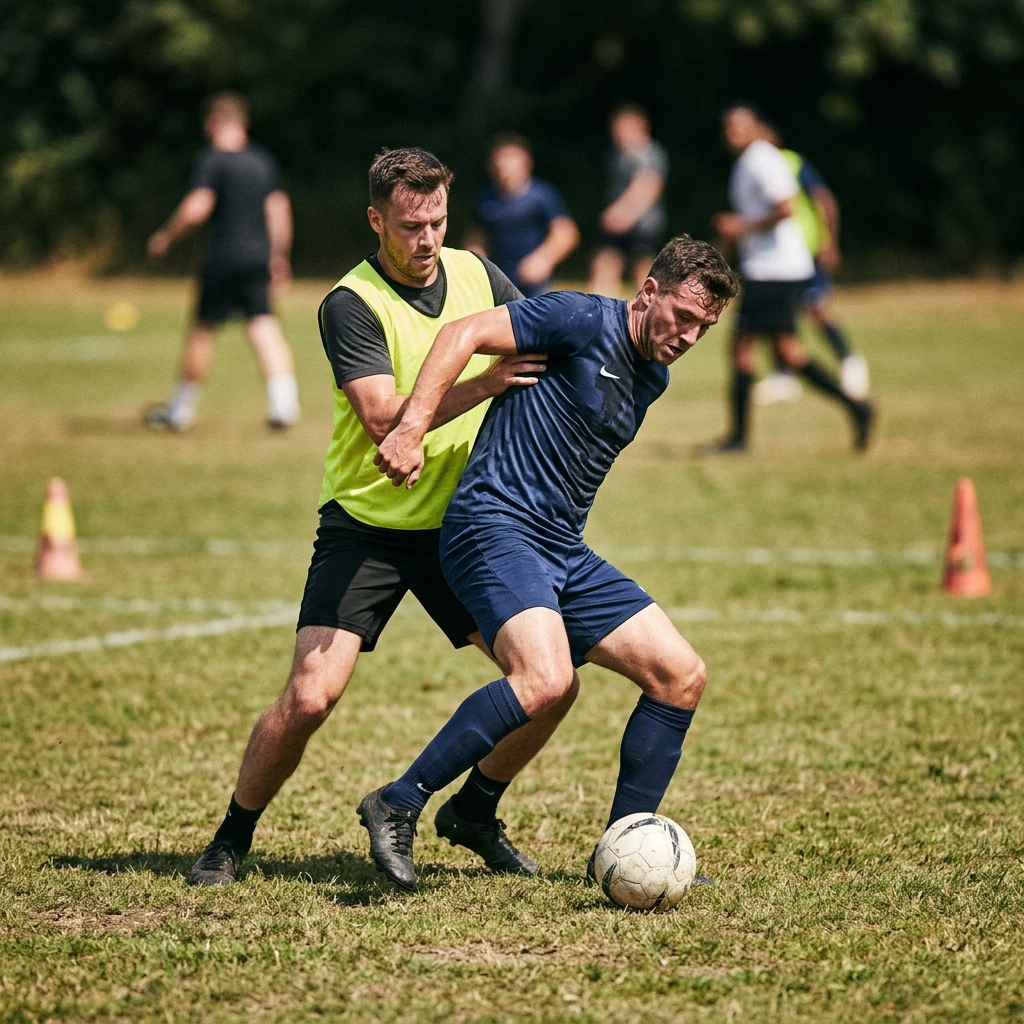
Weeks 4-5: Sport-Specific Phase
Goal: Convert general capacity into match fitness.
The engine is built. Now you make it soccer-specific.
S&C work:
- 2x strength sessions (reduced from 3x to allow recovery from pitch work)
- Maintain strength — you're not building here, you're holding
- Continue eccentric work — this is injury prevention
- Plyometrics increase in intensity and sport-specificity (reactive, multi-directional)
Conditioning:
- High-intensity interval work resembling match demands
- Larger SSGs (6v6, 7v7, 8v8) with work:rest ratios matching competition
- Repeat sprint work with incomplete recovery
- Controlled scrimmages
- Running volume decreases; running intensity increases
The shift: Week 4-5 is about intensity, not volume. Players should be working at near-maximal outputs but with managed total load. Quality over quantity.

Week 6: Taper / Peaking
Goal: Deliver players to match day fresh, sharp, and fit.
This is where many coaches blow it. They keep pushing volume because players "don't look fit enough." Then the team starts the season fatigued.
S&C work:
- 1-2 light sessions
- Maintain intensity on key lifts but reduce volume by 40-50%
- Focus on movement quality, activation, and readiness
Conditioning:
- Reduce total training volume by 30-40%
- Keep intensity high — sharp, short, game-realistic efforts
- Tactical work with some physical demand, but nothing crushing
- Final friendly/scrimmage midweek with reduced involvement for key players
The paradox: Players will feel too good. They'll have energy and want to work. Trust the process. That excess energy is exactly what you want when the first competitive match arrives.
Load Monitoring Throughout
You can't manage what you don't measure.
Track:
- Session RPE (Rate of Perceived Exertion) x duration for training load
- Daily wellness (sleep quality, muscle soreness, fatigue, mood)
- GPS metrics if available (total distance, high-speed running meters, accelerations)
Watch for:
- Sustained spikes in load (acute:chronic workload ratio going above 1.3)
- Cumulative fatigue (players consistently reporting high soreness with poor sleep)
- Performance drop-offs in training (players who were sharp becoming sluggish)
This isn't about being soft. It's about being smart. The goal is to stress players enough to create adaptation without burying them in fatigue.
Tracking RPE, wellness, and workload ratios across a full squad — on paper or in spreadsheets — works for about a week before data starts falling through the cracks. PlayerPlan automates daily wellness check-ins into a single readiness score per player, and ACWR monitoring flags anyone trending above 1.3 before you find out the hard way. One dashboard, entire squad.
The Non-Negotiables
Regardless of how you structure your six weeks, these principles hold:
- Start conservative. Week one should feel easy.
- Eccentric work belongs in every week. Hamstrings and groin injuries drop dramatically with consistent eccentric loading.
- Intensity before volume in the late phase. The last two weeks prioritize quality.
- The taper is not optional. Players need supercompensation to peak for the season.
- Individualize where possible. Returning injured players, new signings, and players with different baselines need adjusted progressions. This is where a platform like PlayerPlan earns its value — build the base 6-week template once, then adjust progressions per player without managing fifteen separate spreadsheets.
What This Looks Like In Practice
Pre-season is when you have maximum control over players' schedules. No matches, minimal external obligations, full access to the squad.
Use that control wisely. Build systematically. Resist the urge to prove fitness through brutality. Trust progressive overload.
The teams that win in March and April aren't the ones who crushed themselves in July. They're the ones who built a foundation that sustained an entire season.
Ready to build your next pre-season block? PlayerPlan's Program Designer lets you map the full 6-week periodisation — Foundation through Taper — with sessions, load targets, and phase transitions built in. Wellness check-ins track how each player responds so you know when to push and when to pull back. Share individualised programmes directly to players' phones. Start your free 30-day trial — 3 players, no credit card required.
How do you currently structure your pre-season? Are you building progressively or just surviving week to week?