You spend pre-season building strength, power, and resilience. By the time January arrives, it's gone. Players are weaker than when the season started, more injury-prone, and running on fumes.
This is the in-season S&C problem. And almost every team at every level struggles with it.
The good news: it's solvable. The solution just requires a fundamental shift in how you think about in-season strength work.

Why Players Detrain
The math is simple. Match days and recovery days consume the week. Coaches prioritize technical and tactical work. Gym time gets squeezed out. When it happens, it's light — maintenance work becomes no work.
Here's what happens physiologically:
Strength: Maximal strength starts declining within 2-3 weeks of detraining. Players who were squatting 1.5x bodyweight in August might barely manage 1.2x by December.
Power: Power drops even faster. Plyometric qualities — essential for sprinting, jumping, cutting — diminish noticeably within 2 weeks of stopped training.
Tissue tolerance: This is the big one. Muscles, tendons, and connective tissues that were prepared for high loads become vulnerable. When an aggressive sprint or change of direction occurs, the tissues can't handle it. Injuries follow.
The season itself is not sufficient stimulus to maintain what you built. Playing matches provides conditioning, but it doesn't provide the progressive resistance needed to maintain strength.
The In-Season Mindset Shift
In-season S&C is not off-season S&C. The goals are different:
Off-season: Build. Develop. Push boundaries. Create adaptation.
In-season: Maintain. Protect. Support performance. Prevent the slide.
This mindset shift changes everything. You're not trying to add 10 kg to a player's squat during the season. You're trying to keep them at the level they reached in pre-season — or at least limit the decline.
Once you accept that maintenance is the goal, the programming becomes clearer.
The Two-Session Rule
Two strength sessions per week is the minimum effective dose for in-season maintenance.
One session doesn't cut it. Research and my own experience confirm that a single session per week results in steady strength loss over a season. Two sessions holds the line.
Three sessions would be better for maintaining strength, but it's rarely feasible with match demands and recovery requirements. Two is the practical sweet spot.
Timing rules:
- Never within 48 hours before a match. Neural fatigue and muscle soreness compromise match performance.
- Ideally 72+ hours from the previous match. Day two post-match is often too soon for heavy loading.
- Match-day minus 3 (MD-3) or minus 4 (MD-4) are the prime windows for strength work.
For teams playing once per week, this gives plenty of options. For teams with congested schedules (twice per week), it gets tighter — you might only manage one proper session with one lighter session.
What Goes in the Sessions
The Non-Negotiables
1. Compound lower body strength
Squats, deadlift variations, split squats, or similar. At least one session per week should include a heavy compound movement at 80-85% of max for 3-4 sets of 4-6 reps.
This isn't about building muscle. It's about maintaining neural drive and tissue tolerance. Heavy loading tells the body: keep this strength, we need it.
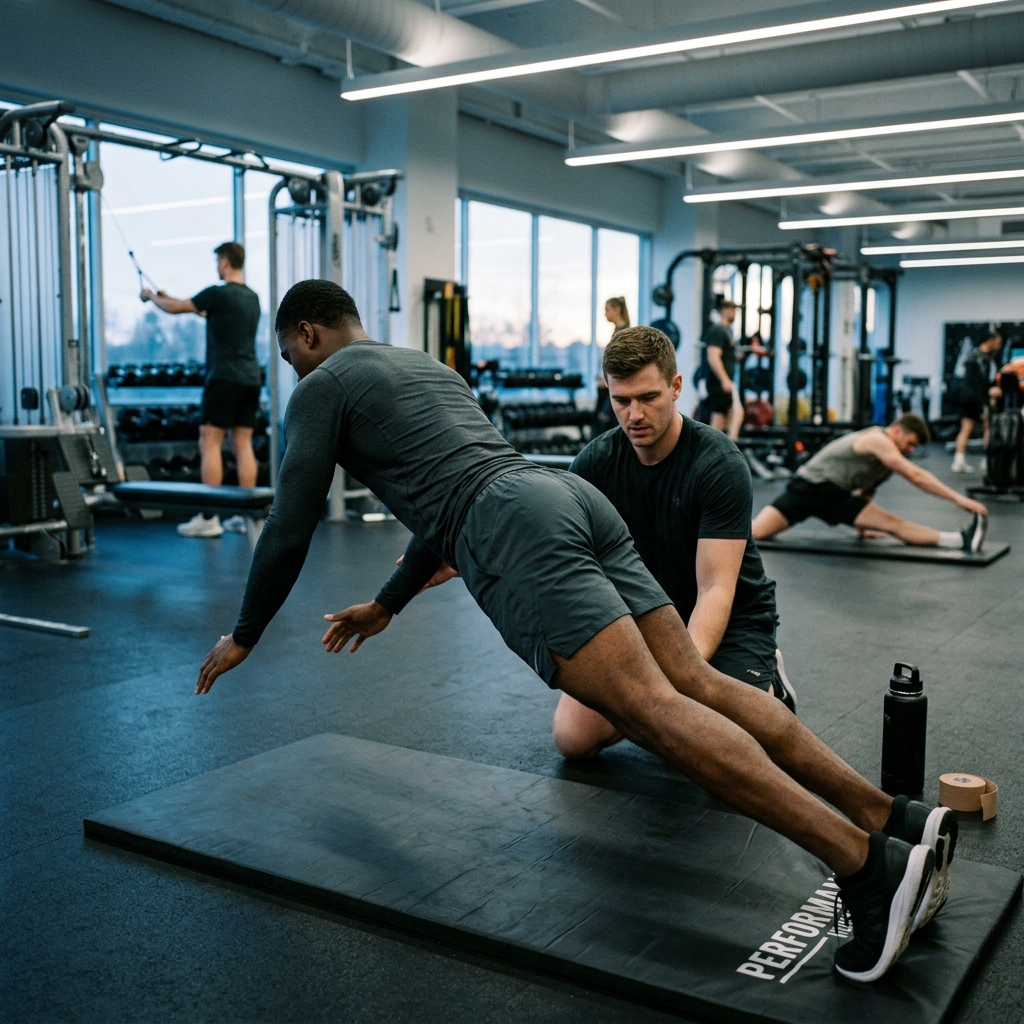
2. Eccentric hamstring work
Nordic curls, Romanian deadlifts, or eccentric-focused variations. Every single week, no exceptions.
The research on Nordics and hamstring injury prevention is overwhelming. Players who do consistent eccentric hamstring work get injured less. Full stop.
I've worked at clubs that implemented mandatory Nordics twice per week for the entire squad. Hamstring injury rates dropped by over 50%. When players skip this work, injuries return.
3. Unilateral work
Single-leg squats, split squats, step-ups. Soccer is played on one leg at a time. Bilateral strength doesn't always transfer to single-leg stability under load.
Include unilateral work in at least one session per week.

The Flexible Components
- Posterior chain accessory work: Glute bridges, hip thrusts, back extensions. Useful but lower priority than the non-negotiables.

- Upper body: Important for injury resilience and winning duels. Can be reduced to one session per week in-season without significant decline.
- Core: Integrated throughout — anti-rotation, anti-extension, rotational patterns. Doesn't need dedicated sessions.
Sample Week Templates
One Match Per Week (Saturday)
| Day | Focus |
|---|---|
| Sunday | OFF / Active recovery |
| Monday | Light gym (30 min): movement prep, activation, low-load accessory |
| Tuesday | Technical training + short speed/power (AM), Gym session 1 (PM): heavy lower, Nordics |
| Wednesday | Tactical training (primary session) |
| Thursday | Gym session 2: moderate lower, unilateral, upper body |
| Friday | Tactical activation (light), travel if away |
| Saturday | MATCH |
Two Matches Per Week (Wednesday + Saturday)
| Day | Focus |
|---|---|
| Sunday | OFF / Active recovery |
| Monday | Gym session (only full session available): moderate load, compound, Nordics, efficient circuit |
| Tuesday | Light activation, tactical prep |
| Wednesday | MATCH |
| Thursday | Recovery, light gym only if tolerated (movement, mobility) |
| Friday | Tactical activation |
| Saturday | MATCH |
In congested weeks, you accept that one session is better than zero. Keep the Nordics in — that's non-negotiable even if you only have 20 minutes.
Managing Fatigue and Freshness
In-season training walks a tightrope. Load enough to maintain adaptation, but not so much that you compromise match performance.
Signs you're loading too much:
- Players report heavy legs consistently on match day
- Power output in gym sessions declining week over week
- Increase in soft tissue complaints
Signs you're loading too little:
- Strength tests (if you do them mid-season) showing significant decline
- Players reporting they feel weak or underpowered
- Increase in non-contact injuries
Adjustment levers:
- Volume is the first thing to reduce. Keep intensity (weight on the bar) but do fewer sets.
- Move sessions further from matches if players aren't recovering.
- Reduce gym frequency during fixture congestion.
Tracking these signals across an entire squad — flagging who's trending toward overload and who needs more stimulus — is where notebooks and gut feel break down. PlayerPlan's daily wellness check-ins turn sleep, soreness, and fatigue data into a single readiness score per player, and ACWR monitoring flags workload spikes before they become injuries. The tightrope gets a safety net.
The Investment Pays Off
Players who maintain strength through the season:
- Get injured less (especially hamstrings, groins, and knees)
- Maintain speed and power into the final months
- Recover faster between matches
- Perform better in the decisive games
The teams that fall apart in March and April are often the teams that abandoned the gym in October.
Two sessions per week. Never skip the Nordics. Keep the big lifts in. It's not glamorous work. But it's the work that sustains a season.
PlayerPlan makes in-season S&C practical at scale. Build your two weekly sessions with prescribed exercises, sets, reps, and load — then share them directly to each player's phone. The Program Designer maps your full in-season block so you see exactly when to push and when to back off across congested fixture runs. No more losing your gym programme to a shared Google Sheet. Start your free 30-day trial — 3 players, no credit card required.
What does your in-season S&C setup look like? Are you maintaining or watching it slip away?