Speed kills in soccer. Every coach wants faster players. But here's what nobody talks about: the players getting injured — ACL tears, hamstring strains, ankle sprains — aren't getting hurt accelerating. They're getting hurt decelerating.
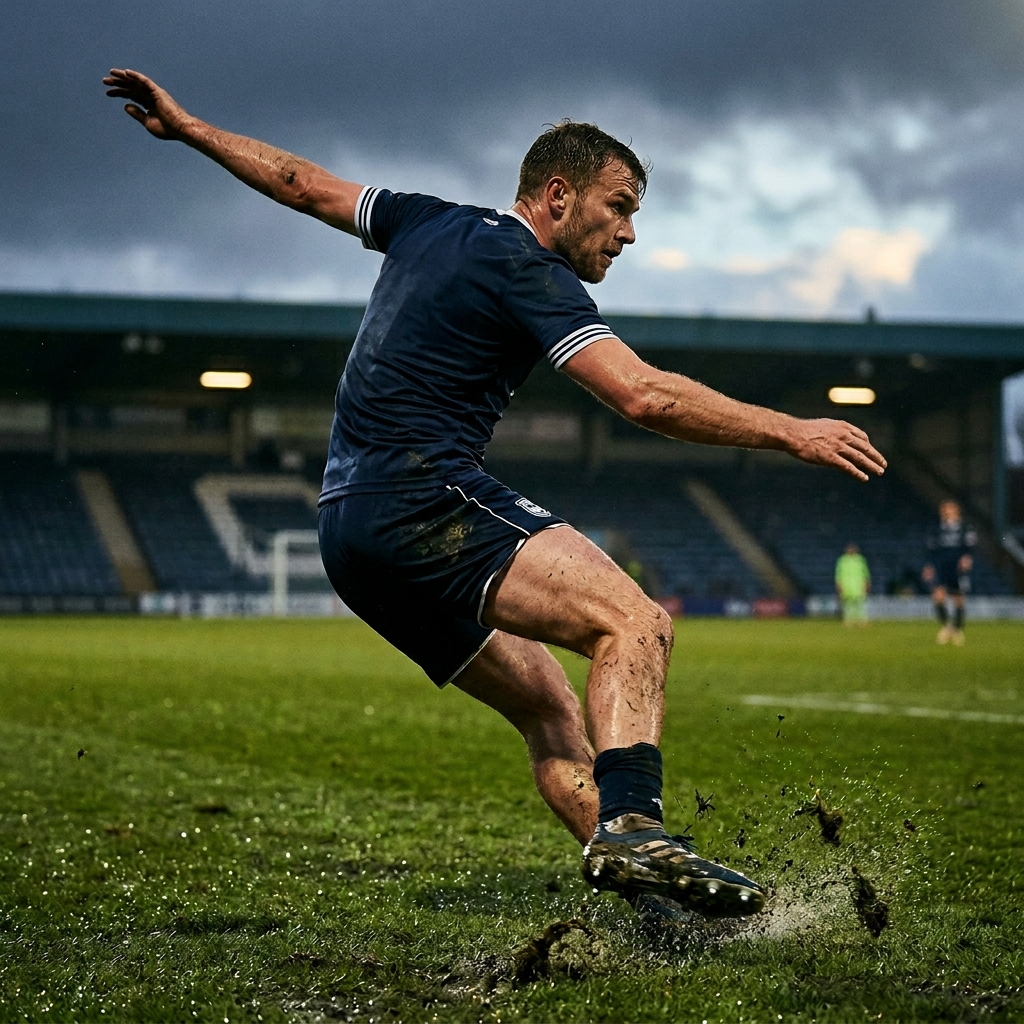
Watch any ACL injury replay in slow motion. The player isn't sprinting. They're planting a foot to change direction, landing from a header, or braking hard to adjust to a deflected ball. The mechanism is deceleration — the body absorbing force it wasn't prepared for.
Yet walk into any training ground in the world, and you'll find coaches running sprint drills, acceleration work, and top-speed sessions. Almost nobody is systematically training their players to stop.
Why Coaches Neglect Deceleration
It's invisible. When a winger burns past a full-back with a burst of acceleration, the crowd reacts. When a centre-back decelerates perfectly to adjust their position and intercept a through ball, nobody notices. The sprint gets the highlight reel. The stop doesn't even get a mention.
Deceleration is also harder to measure. We have GPS units tracking top speed, sprint distance, and high-speed running metres. But braking metrics? Most coaches aren't looking at them, and until recently the frameworks to assess them barely existed. No scouting report has ever listed "elite decelerator" as a key attribute. Add to this the fact that acceleration work just feels more productive — players enjoy it, it looks impressive, and it maps neatly onto the speed metrics everyone already tracks. Deceleration training, by contrast, is demanding, unglamorous, and often perceived as injury rehab rather than performance work.
That perception is exactly backwards.
What the Evidence Shows
The research is unambiguous: deceleration is where injuries happen, and improving deceleration capacity is one of the most effective ways to keep footballers on the pitch.
Hamstring Injuries: An Eccentric Problem
Hamstring strains are the single most common injury in professional soccer/football, accounting for up to 37% of all muscle injuries. The majority occur during the late swing phase of sprinting and during rapid deceleration — both moments where the hamstring is under significant eccentric load, lengthening while producing force. A landmark meta-analysis covering 8,459 athletes found that the Nordic hamstring exercise alone reduced hamstring strain injury incidence by 51% (van Dyk et al., British Journal of Sports Medicine, 2019). The mechanism is straightforward: Nordics train the hamstrings eccentrically at long muscle lengths, which is precisely where the tissue fails during high-speed deceleration.
ACL Tears: A Deceleration Crisis
Approximately 70-80% of ACL injuries in football are non-contact — meaning no tackle, no collision. The athlete tears their own ligament. The mechanism is almost always the same: deceleration combined with a change of direction, with the knee collapsing into valgus under forces the athlete cannot control (Boden et al., Journal of the American Academy of Orthopaedic Surgeons, 2010). Neuromuscular training programmes that include deceleration mechanics, landing control, and eccentric strength have been shown to reduce ACL injury rates by 51-62% across multiple meta-analyses. The FIFA 11+ programme, which incorporates these elements, demonstrated significant reductions in overall lower-limb injury rates in soccer populations.
Change of Direction Deficit: The Deceleration Fingerprint
Here's where it gets interesting for performance coaches. Nimphius et al. introduced the concept of the change of direction deficit (COD deficit) — the difference between an athlete's linear sprint time and their time through a COD test over an equivalent distance. Research on elite young soccer players (Loturco & Nimphius, German Journal of Exercise and Sport Research, 2018) showed that traditional speed-power measures correlated poorly with COD ability, but strongly with COD deficit. In practical terms: the gap between how fast a player runs in a straight line and how fast they change direction is largely a deceleration problem. Improve braking mechanics, and COD performance follows. In a 505 COD test, only 31% of total time is spent in the actual turn — the rest is deceleration and re-acceleration.
The Load Nobody Accounts For
Recent work by Harper et al. (2024) in the Braking Performance Framework found that high-intensity decelerations impose up to 65% greater mechanical load per metre than any other match-play activity, and roughly 37% more than equivalently intense accelerations. Yet most training load monitoring focuses on acceleration and high-speed running distance, systematically underestimating the eccentric demands players face in matches. Players are accumulating massive braking loads in competition that they've never been exposed to in training.
What Coaches Should Do Instead
Deceleration training isn't complicated. It requires intentional eccentric loading, progressive braking drills, and landing mechanics — all integrated into the existing training week. Here are five exercises that form the foundation.

1. Eccentric Nordics
The gold standard for hamstring health, and the single most evidence-backed exercise for reducing hamstring injuries in football.
How to do it: Kneel on a pad with ankles secured (partner hold or strap). Keep hips locked in extension — no bending at the waist. Lower yourself as slowly as possible toward the ground, resisting gravity with your hamstrings. Catch yourself with your hands and push back up. The eccentric lowering is the training stimulus — don't worry about pulling yourself back up concentrically.
Prescription: 3 sets of 5-6 reps. Tempo: 3-4 seconds on the lowering phase. Rest 90 seconds between sets.
Coaching cue: "Straight line from knee to shoulder the entire way down. The moment your hips break, the hamstrings lose tension."
2. Deceleration Runs
Teaches athletes to dissipate force over multiple ground contacts rather than jamming the brakes in a single step.
How to do it: Sprint at 80-90% effort for 20 metres, then decelerate to a complete stop within a marked 5-metre zone (3-4 steps). Focus on lowering centre of mass, increasing ground contact time, and absorbing force through the whole foot — not slamming the heels.
Prescription: 4-6 reps with full recovery (60-90 seconds). Progress by narrowing the deceleration zone from 5 metres to 3 metres over several weeks.
Coaching cue: "Sit back into the stop. Hips drop, chest stays over knees, arms drive back. You're a car with anti-lock brakes, not a car hitting a wall."
3. Drop Landings
Teaches force absorption and eccentric stiffness in the ankles, knees, and hips — the foundation of all deceleration mechanics.
How to do it: Step off a 30-40cm box (not jump). Land on both feet and stick. Hold the landing for 2 seconds with knees tracking over toes, weight through the midfoot, and no excessive forward lean or valgus collapse. Progress to single-leg drop landings once bilateral mechanics are clean.
Prescription: 3 sets of 5 reps (bilateral), progressing to 3 x 4 per leg (unilateral). Rest 60 seconds between sets.
Coaching cue: "Land quiet. If I can hear you land, you're not absorbing force — you're crashing."
Building deceleration progressions for individual players alongside their acceleration work is exactly the kind of programming challenge that gets messy in spreadsheets. PlayerPlan's Program Designer lets you layer eccentric and braking work into each player's weekly plan and adjust loads based on match schedule — so nothing gets missed and nothing overlaps.
4. Chaos COD Drills
Reactive deceleration under cognitive load — the closest you'll get to replicating match demands in a controlled environment.
How to do it: Set up a 10x10m grid with four cones. The athlete starts in the centre. A coach or partner calls or points a direction. The athlete sprints to the cone, decelerates, returns to centre, and immediately responds to the next cue. Randomise the cues. Add a ball. Add a defender. Layer complexity.
Prescription: 4-6 sets of 15-20 seconds of work, with 45-60 seconds rest. Keep the work intervals short — this is a neural quality, not a conditioning drill.
Coaching cue: "Eyes up before you move. The deceleration starts before you arrive — read the cue early and pre-brake."
5. Eccentric Split Squats
Heavy, slow-tempo eccentric loading that builds the braking strength needed to absorb deceleration forces through the entire lower limb.
How to do it: Rear foot elevated on a bench. Hold dumbbells or a goblet load. Lower for a 4-second count into the bottom position, pause for 1 second, then drive up at normal speed. The 4-second eccentric is non-negotiable — it's where the adaptation happens.
Prescription: 3 sets of 6-8 per leg. Tempo: 4-1-1 (4s eccentric, 1s pause, 1s concentric). Rest 90-120 seconds between sets. Load progressively — start conservative.
Coaching cue: "Control the descent like you're lowering yourself onto a landmine. Slow, deliberate, and stable through every centimetre."

Sample Weekly Integration
Deceleration work doesn't need its own day. It integrates into the existing microcycle around match demands.
| Day | Focus | Deceleration Work |
|---|---|---|
| MD-4 (e.g., Tuesday) | Strength & power | Eccentric Nordics (3x5), Eccentric Split Squats (3x6/leg) |
| MD-3 (e.g., Wednesday) | Speed & agility | Deceleration Runs (5 reps), Drop Landings (3x5) |
| MD-2 (e.g., Thursday) | Tactical / technical | Chaos COD Drills (4x15s) integrated into small-sided games |
| MD-1 (e.g., Friday) | Activation / light prep | Light reactive COD only (low volume, low intensity) |
| MD (Match Day) | Competition | — |
| MD+1 (e.g., Sunday) | Recovery | Pool recovery, mobility, no eccentric loading |
Key principles:
- Eccentric strength work goes furthest from match day (MD-4) to allow recovery
- Deceleration runs and plyometrics slot in at MD-3 when neural freshness is still high
- Reactive/chaos work can integrate into tactical sessions at MD-2
- Nothing heavy within 48 hours of competition
FAQ
How do you test deceleration ability?
The simplest field test is the change of direction deficit. Run a 10m or 20m linear sprint, then run a COD test (505 or modified zigzag) over the same distance. The time difference isolates deceleration-reacceleration ability from raw speed. A larger deficit means poorer braking mechanics. GPS units with accelerometer data can also track deceleration events above threshold (e.g., >3 m/s²), but the COD deficit is accessible to any coach with a stopwatch and two cones.
Is deceleration training safe for youth players?
Yes — and it's arguably more important for youth populations. Young athletes are developing movement patterns that will carry into adulthood. Teaching proper landing mechanics and braking technique early creates a protective foundation. Start with bodyweight drop landings and deceleration runs. Progress to loaded eccentrics (Nordics, split squats) as training age increases. Avoid high-intensity reactive drills with athletes who haven't mastered basic landing and stopping mechanics.
How does deceleration training reduce hamstring injuries?
Hamstring strains occur when the muscle is forcefully lengthened beyond its capacity — an eccentric failure. Deceleration training (particularly Nordics and eccentric split squats) increases the hamstring's ability to produce force at long muscle lengths, raises the threshold at which tissue damage occurs, and shifts the muscle's peak torque angle toward longer lengths. In short, you're building a hamstring that can handle bigger braking forces without tearing.
Can you train deceleration without equipment?
Absolutely. Deceleration runs, drop landings from a step or low wall, bodyweight Nordics (partner-assisted), and chaos COD drills all require zero equipment. The most important element is coaching intent — athletes must understand they're training the stop, not just resting between sprints.
How often should soccer players train deceleration?
Two to three dedicated sessions per week during preseason, reducing to two maintenance sessions in-season. Eccentric strength work (Nordics, split squats) needs a minimum of one session per week to maintain adaptations. Deceleration runs and reactive COD can be woven into regular speed and tactical sessions without adding extra training time.
Stop Training Players to Go Fast Without Teaching Them to Stop
Every time a player tears their hamstring pulling up from a sprint, or ruptures an ACL planting to change direction, we should be asking: did we prepare them for the forces of deceleration?
The research is clear. The drills exist. The programming isn't complicated. What's been missing is the intent — coaches deliberately and systematically building braking capacity alongside the speed and power work they already prioritise.
PlayerPlan makes this practical. The Program Designer lets you build multi-week periodised plans that layer deceleration and eccentric work into each training phase — preseason through in-season. Share individual programmes directly with players so they can complete eccentric sessions at home or in the gym, with exercise videos and load prescriptions built in. No spreadsheets. No guesswork. No players falling through the cracks.
Start your free 30-day trial — 3 players, no credit card required.